
Muster 2026 AAR
On April 17-19, 2026, our group ran our second Muster at Prince William Forest park near Washington, DC. It is a historical training event that recreates elements of historical musters - gathering of troops for inspection or preparation for battle. Our overall goal is an event packed with training that is an accessible bridge towards higher fidelity events like Arne Koets’s Feldlager in Germany. Overall, I consider the event even more successful than the last, but there were a few things I would change if I were to redo it again, and some changes I will make for 2027.
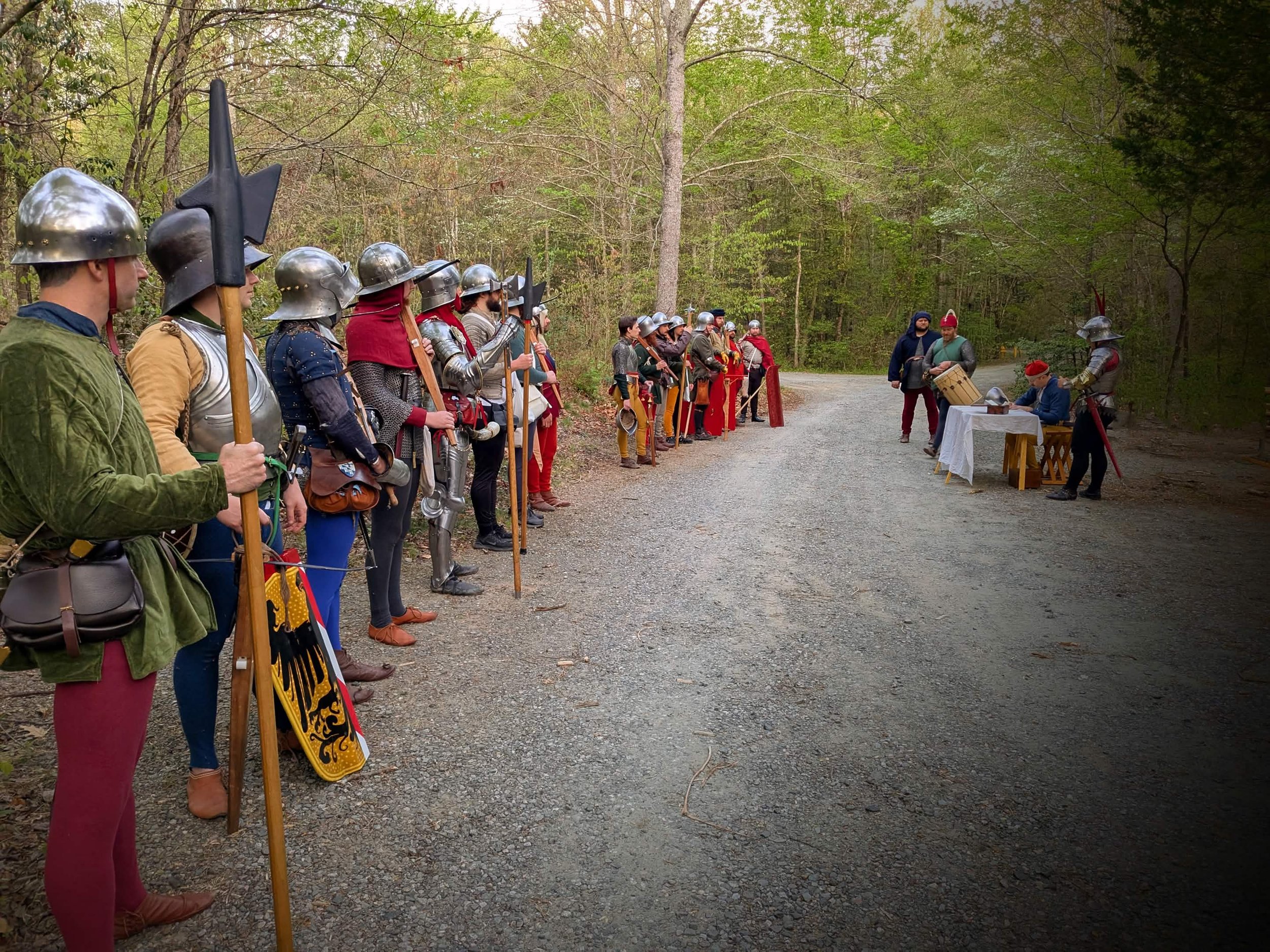
Inspection and Pay at Muster 2026.
A short overview of the events:
- Night Watch
- Inspection and pay
- Basic Training with Pikes and Crossbows
- Combined Arms Drill
- Night Mission, Reconnaissance and Assault
- Patrol
Compared to last year, I aimed for a tighter, more structured event, because I had a much clearer vision of what the event could be, and what our people could accomplish. I delegated more work because the people that were participating were also more skilled and understood the vision more than last time. Last year I tried to do as much as possible personally, at the expense of structure and scale, in order to convey the specific vision. In addition, I handed off the role of captain to Will Buschur midway through the Muster, which freed up a lot of time and energy to focus on other roles.
Last, I made some small steps towards casting our group as militia from Nuremberg. This decision is tricky, because we still need to do more research. Some initial choices we make will almost certainly be incorrect, but we are committed to researching and improving our work.
Setup and Intro
We started setup on Friday evening, and started dinner at 1900. This year I required the dining hall to have historical foods and utensils only, which dramatically improved the feel. Last year I did not have this requirement, because we were comprised almost entirely of new people who were just struggling to get basic kit together. In the future, I'd like to explore more low hanging fruit that can improve the feel of the dining hall.
By using a cabin camp, Muster is able to cut down on setup and takedown at the cost of immersion, so I think spending some of the time we save to reinvest in the appearance can improve the immersion of the event.
Watch
The first exercise of the event was watch. The goal of this exercise is to ease people into the event, and to accustom them to working at night. The main group was instructed to guard two items - the captain's laundry and his horse (a rope tied to a beam). These items are inspired by an anecdote from Le Jouvencel, a late 15th century semi-autobiographical chivalric romance by Jean de Bueil. An opposing group of five people was instructed to test the watch on “easy mode” - if the guards were doing their job, and not unlucky or grossly incompetent, they should succeed.
This training paradigm is important to highlight. For exercises where there is an antagonist, rather than both teams receiving instructions to "win at all costs," the main group is instructed on the goals and general methods, and instructed to try their best to achieve them. The opposing group's job is to facilitate the main group's training, whether it succeeds or fails in its nominally assigned task. This is in contrast to many other events, where activities are structured symmetrically, with both sides encouraged to "win," or are heavily scripted. This asymmetric setup is very similar to agent/patient roles in fencing - one side is trying to execute a technique, while the other side is trying to facilitate the training, provide plausible and useful resistance, and allow themselves to be hit if the technique being trained is properly executed.
The main group used two guards per shift, and the opposing group found that the gravel of the roads combined with the brush off road made stealth extremely difficult. All of the opposing group were successful in plausibly testing the main group, and were discovered. One person (Walker Skaggs) actually camped underneath the building before the start of watch, and remained there for two hours before being discovered.
In retrospect, as I fell asleep that night one of my concerns was that a venomous snake was underneath one of the cabins. In future iterations I might make cabin crawl spaces off limits, or require the opposing group have some sort of safety check in.
Stand To, Inspection, Pay
In the morning, the entire group woke up and got ready for stand to half an hour before sunrise. They were instructed to be ready with helmet and sidearm at 0600. Stand to is when a group maintains a state of readiness in anticipation of a potential attack. In this case, I want people to be used to getting up early and arming in the dark, and from an event organizer perspective, this allows us to get the most out of available daylight.
After breakfast, we conducted a short inspection and pay ceremony. This ceremony is a blend of the harness showing, ordinary musters, and emergency musters for external deployments. We inspected everyone's equipment, recorded it, and paid each person. For pay, I handed out replicas of Prague groschen for most of the people, and florins for the officers - a small amount of a few days' wage that basically compensated them for the time spent at Muster.
For an ordinary late 15th c. German citizen militia, showing up for an ordinary muster, harness showing, or wall duty would actually be an uncompensated obligation. However, for external long distance deployments monetary compensation is more common. Nevertheless, I am likely to keep payment for several reasons. First, the pay structure allows me to publicly and socially incentivize certain behaviors, and de-emphasize others. In this case, I want to reward people who take on leadership or specialist roles (scribe, musician, etc.) or otherwise go above and beyond to make the event a success. I did not pay people an extra amount based on their equipment, because I do not want to incentivize people to collect armor that i) they do not have the fitness to work with or ii) is a poor recreation of a historical example. Second, the coins act as a souvenir of the event, and function as small tokens of gratitude that people can pass to each other.
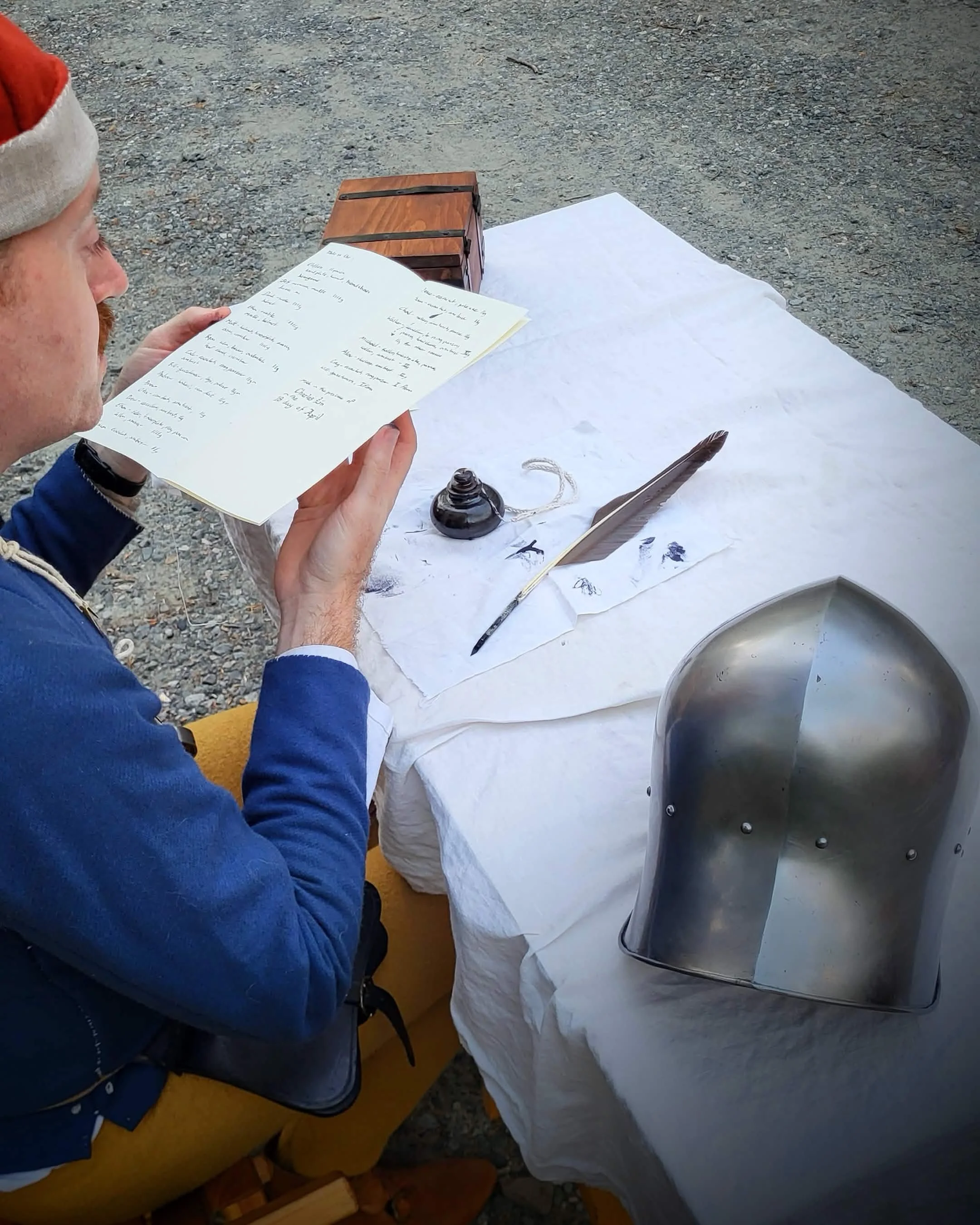
Our scribe, David Covington, finishing the muster roll.
This year the pay ceremony went by quickly and efficiently. In the future, I am looking to mint coins specific to Nuremberg, and possibly add a counting board if our numbers require it.
Basic Training Blocks: Crossbow and Pike
Afterwards, the main group broke into two subunits, Group 1 and Group 2, and each did two basic training blocks of 2.5 hours each.
For the pikes, our goal was to train new and returning people to the new set of commands, developed by Craig Kellner, based on DeGheyn's 1607 English treatise. It is more than a hundred years after our time, but it is currently the closest that we have for a detailed source on weapon handling. For returning people, the main challenge was trying to forget the old system of commands we had developed in 2025. Last year, because we were under time constraints to create a unit from whole cloth that could deploy to Feldlager, we made compromises by filling in modern military commands and timing.
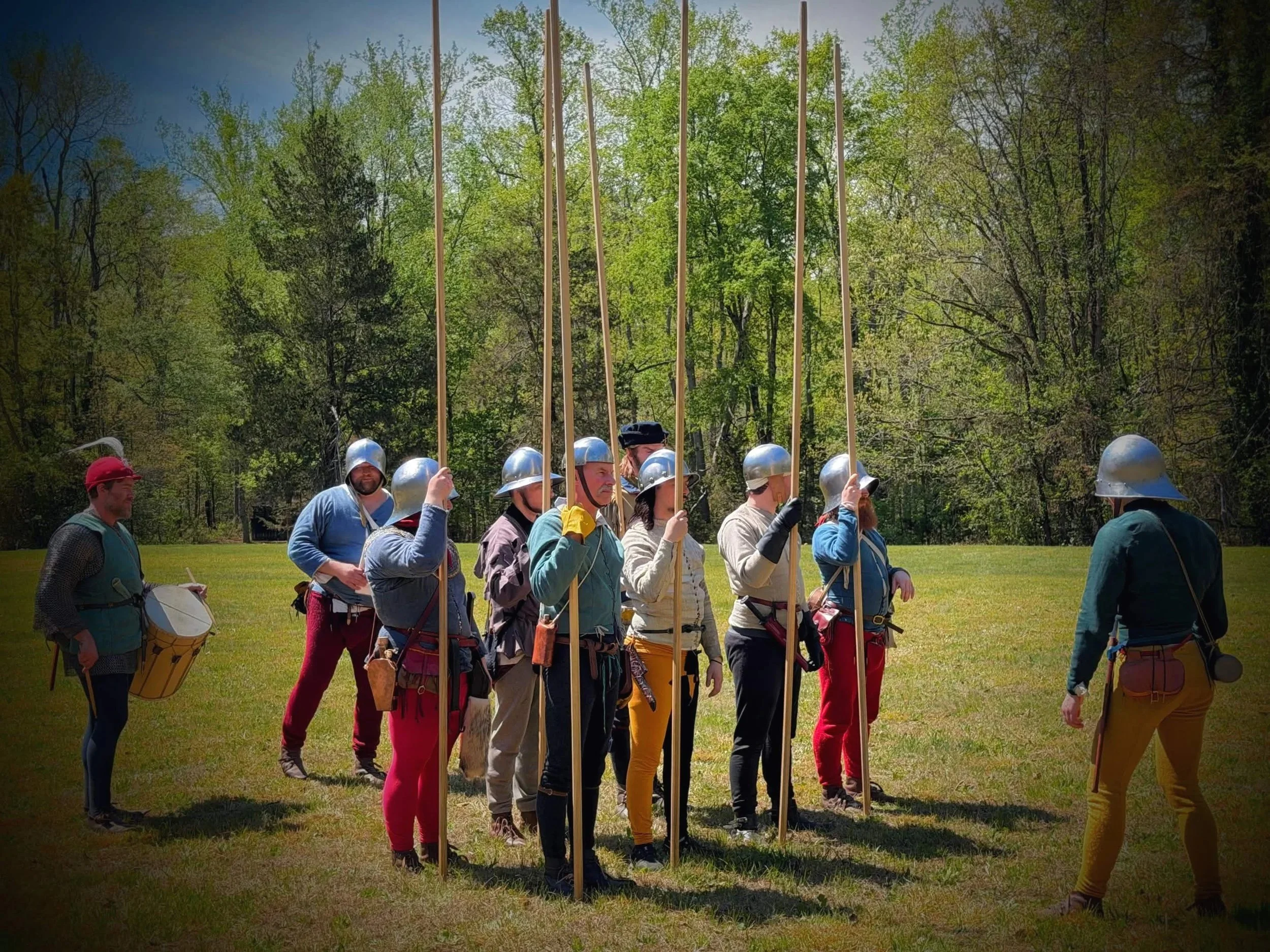
Group 2 training with pikes.
This made training pretty quick, as we had several former military within the group who could both teach formation commands and serve as examples, but it made our movements unnaturally crisp and precise. Our goal with the new commands was to "jankify" our commands, rely on the timing of a musician more, and overall move towards a premodern, preprofessional feel. I wanted an organic, hand-made feel to our commands and movement, and not an unnatural CNC one.
For crossbows, our goal was to train new people to basic safety and familiarization, while for returning people, it was to improve our accuracy. We used new angled wood-bolts that I had made, which were an improvement over the first generation's plastic fletching, both in feel and accuracy. I consider the tactile experience an important part of Muster. The heft of an ash pike vs. a pine one, the feel of wood fletching vs plastic, and the sound of a sidearm being drawn from its scabbard rather than unceremoniously drawn from a belt are all small details that form the foundation of an immersive experience. Where practical and safe, I think it is important to reduce the compromises in this area.
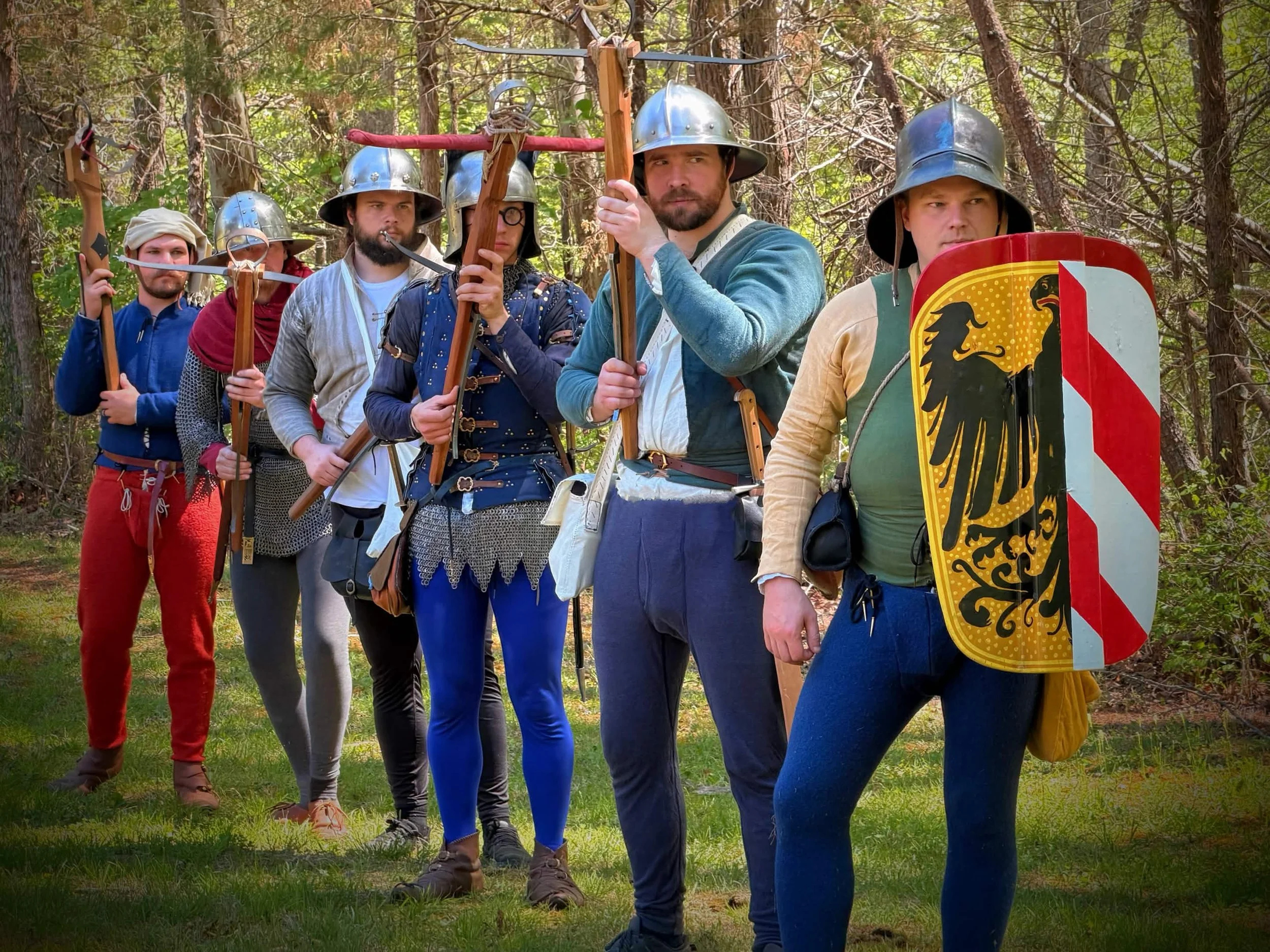
Group 1 training with crossbows and pavise.
Overall, I am happy with how the blocks went. We had to issue a few safety warnings, which emphasized the importance of early safety training, but we achieved our goals. In fact, I had underestimated how good everyone had become, and overestimated how long each training block needed. In the future, I am considering i) further shorten training blocks by 30-60 min (this is important for reasons I will discuss later) ii) drop new people into the deep end for pike and formation commands and promote "learn by doing," and iii) devoting an entirely separate block for crossbow newbies.
Combined Arms Drills
Afterwards, we combined the arms together to do some very basic drill while firing blunt bolts. One group used crossbows, while the other used pikes. The primary goal for the crossbows was to independently move when ordered to, but to coordinate shooting with the pikes. For the pikes, this was further training in formation commands, but also presented plausible battlefield scenarios so that they could understand the usual sequence of events and predict likely commands.
- Drill 1. Deploy from column to line. Crossbows shoot at enemy. Pikes advance to target, while crossbows transition to melee.
- Drill 2. Deploy from column to line. Crossbows told to move forward and shoot at enemy. After a short while, pikes advance to target, while crossbows transition to melee.
- Drill 3. Deploy from column to line. Crossbows told to move forward and shoot at enemy. After a short while, they are recalled back to the protection of the pikes.
- Drill 4. Deploy from column to line. Crossbows shoot at enemy. After a short while, pikes retreat as crossbows provide cover.
- Drill 5. Start in line facing enemy. Crossbows shoot at initial enemy. Pikes identify an additional enemy, and wheel to face the new target. Crossbows reposition to the new flanks, and continue fire on the first target if safe to do so.
The weather was very hot and people were exhausted, so we ran each drill once. I think if the weather was cooler we could have run each drill a few times and improved our performance. Overall, the training was successful, but several improvements could be made in the future. For pikes, I think we held at charge arms for too long, they should have remained at advance or port arms until imminent contact. This saves the arm strength of the soldier, and makes them more effective in the ensuing melee. Creating a clearer marker of the enemy's actual range would be a good indicator to the officers of when charge arms was necessary.
For crossbows, placement and the rhythm of assault was a bigger challenge. Switching from formation to independent movement and vice versa at the appropriate time was challenging, and I think clearer explanation on my part could have improved the exercise. In addition, keeping the rate of shots up immediately prior to melee contact, and timing the assault of the crossbows with the forward edge of the pikes should be a key goal that I should have articulated.
It was also during this block that I handed over command to Will by handing him my magnetic plume holder. I love the symbolic meaning of it, but I need to find a way to make it stay in place better.
Night Mission
After dinner, we began preparations for the night mission. The main group, commanded by Will was tasked with scouting an enemy location, and then capturing a bridge to clear the path for a larger army that would advance in the morning. I served as a referee and observer along with one other person.
While I briefed the officers of the main group roughly a week before the event, I purposefully did not brief the rank and file on this mission for several reasons. First, I wanted to give the officers the practice of preparing for and briefing a mission. Second, I wanted the rank and file to have the experience of being briefed during the event. Last, I wanted the officers to have an information and preparation advantage over their soldiers, as if orders had been passed down from higher rank. In these types of exercises, when the briefing is presented to both leaders and soldiers simultaneously, it's very common for untrained people to try to lead, by presenting "good ideas" or otherwise try to distinguish themselves with suggestions that merely slow down the preparation process. Structuring preparation in this way presents a clearer signal to the rank and file - the mission has been considered deeply, these people are in charge, the plan is set, here is your task, do it well.
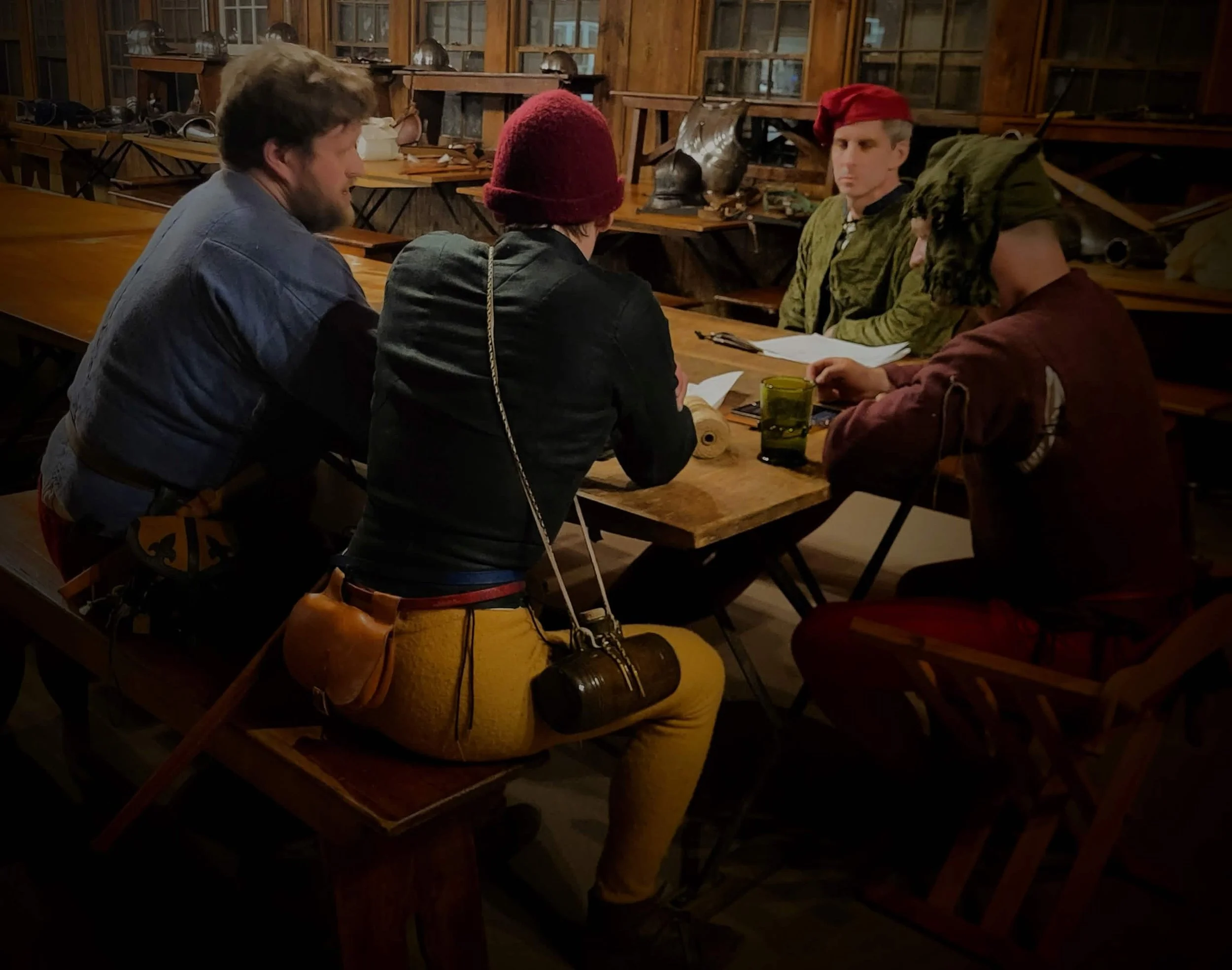
The officers plan for the night mission.
After an administrative movement of about one mile, the main group set up their rally point and prepared for the reconnaissance portion. For administrative reasons, we prescribed a specific rally point to punctuate the reconnaissance and assault objectives. Because of this, the officers did not get as much latitude in planning, but the exercise still gave people practice with many specific tasks, such as briefing, equipment and personnel selection, timing and other decisions, so I am satisfied with this decision.
The opposing group, led by Bill Grandy, comprised of five hand picked people who were to roleplay a much larger enemy force that the main group was to identify and send a [notional] messenger back to the main army about. These people were picked because I could trust that they would understand the intent of the exercise and act plausibly. In fencing, this is a partner you could trust to help you do a tricky drill, and not mess it up by trying to "win." The opposing group was instructed to start a fire in an external fireplace, and relax and chat, but were given a radio and told to be ready to launch a patrol if directed. This modern artificiality is a break in immersion for the opposing group, but was a contingency to maximize the training value of the main group. If I needed to generate contacts or other activity for training purposes, I could do it easily by radio.
The main group sent three teams of two to scout each of the three clusters of cabins that the enemy could potentially be in. Each was led by an officer, and Will stayed with the remainder of the main group at the rally point.
All three groups departed from the rally point as the sun set, and slowly made their way towards their objectives. Because of how well noise carried, all three scout teams could hear the opposing group chatting and laughing roughly 120m away. Two of the teams waited at this distance until it grew very dark before proceeding. Craig Kellner and Sam Nolledo were assigned to scout the cluster that had the opposing group, and made it within 15m of the enemy house. Unfortunately the team was spotted, but they were able to safely escape. Although they were able to identify the location and rough number of enemy, they were unable to spot the banner and identify the group. Moreover, they alerted the opposing group to suspicious activity in the area, and they blew a horn as an alarm.
The other scout teams were on their way back or had already returned, but upon hearing the horn quickened their pace. Even though I had night vision and thermals, I lost contact with Craig and Sam. I had to check in with Bill and the opposing group for a quick report, and by the time I was ready to find them they were probably already back with the main group.
When all of the scout teams returned, Will decided to move towards the bridge for the assault. The bridge was guarded by six soldiers, represented by cardboard targets. Will sent a scout team of three (Simon Whittle, Chad Skaggs, and Drew Schulz). However, because of a lantern that had been set up at the post, the scouts had trouble discerning the paper targets, and were forced to attack the guards there when they spotted them, rather than report back to the main group to help them prepare for the assault.
Because they were paper targets and didn't fight back, they dispatched the targets and the main group captured the bridge. Because I was still en route after observing the reconnaissance task, I was unable to referee this directly. However, I judged ex post that all three scouts would have been killed in the assault. Being outnumbered and outarmored, and being mutually surprised, the scouts would have been badly outmatched. But, the commotion would have created enough noise for the main group to move to action and crush the guards at the bridge.
I am happy with the night mission and its outcome, and I think we completed our training objectives. My main focus for next year is on how to tighten up this exercise so that it consumes less resources - time, energy, and planning - while still achieving these objectives. We expended four hours for the night mission from briefing to completion, and I'd like to tighten it up and see if we can get more value out of it. For a day where people woke up at 0600 or earlier, asking some of them to sit in a dark field for an hour waiting for a scout team to return does not have as high training value as I'd like.
One administrative challenge of designing an exercise like this is that nearly everyone wants to do cool night stuff, and there are way more people than what would actually be needed for a plausible night exercise. I'm going to think about whether the overall narrative of a mission - infil, rally points, objectives, and exfil - is actually necessary, or whether fixed stations with miniature objectives can keep most groups occupied with specific tasks. For example, rotating small groups between reconnaissance, assault, and infiltration stations with 1 hour completion times.
Another alternative I am considering is completely scrapping night missions, in favor of conducting a similar mission during the day. This would present less of an administrative burden and safety risk, while continuing to give officers the valuable planning and briefing training. This might necessitate an extra day for Muster, which I am also considering.
Stand To, Review
The group stood to half an hour later than last time at 0630, and were briefed on the outcome of the previous night's events. They had successfully captured the bridge, but suffered three casualties. They had identified the location of enemy forces within town, but had misidentified the enemy forces by relying on contextual clues to form an educated guess.
In the briefing for the reconnaissance portion of the night mission, I mentioned the enemy could have one of four banners - Brandenburg, Franconia, Hohenzollern, and Verloren Schutzen, our old Feldlager '25 unit. They knew I had our old Feldlager banner, but unbeknownst to them, I had secretly created the Hohenzollern banner as well, just in case they were relying on the fact that they knew I already had the older banner and would recycle it.
I devoted time to sewing this banner and keeping it secret because I wanted to make a point - there is the exercise as we intend to run it, in its purest state, and then there is meta knowledge that we all have about what the parameters of the event could be. For example, they knew I had one of the banners, so it was likely that one. Similarly, they know how many people are pulled from the main group to form the opposing group, so they could abuse that knowledge when doing their in-exercise reconnaissance. Just like in fencing, as soon as someone beings to play the game rather than train, it is important to break the game to preserve the training.
Patrol
On Sunday morning, two patrols were launched to clear the roads, presumably of remnants of the defeated army from the early morning. One patrol was launched south, and after a return to base the second was launched north. In each patrol, the goal was to have a small column of pike protected by a screen of crossbowmen. Will remained captain, and each group had a chance to do a patrol as pike and as crossbowmen.
The goal was to train the group to react to different types of contacts while on the march. I served as the solo opposing member, and began with a set of flags to represent an enemy unit, and the colors of the flag represented expected responses from the main group - attack Red, hold position against White, retreat from Blue. I ran ahead of the main group and set up encounters, and stayed in contact by radio.
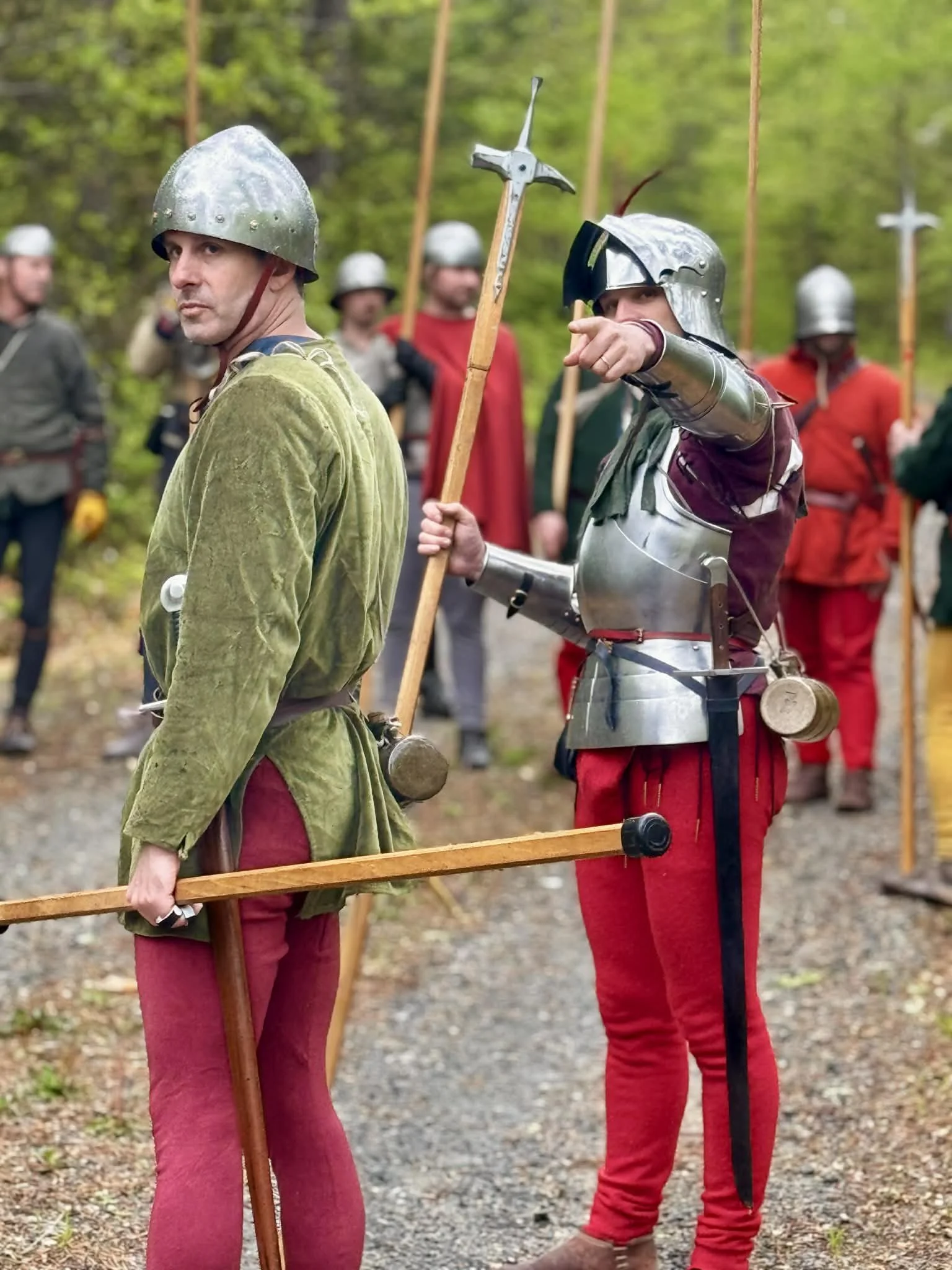
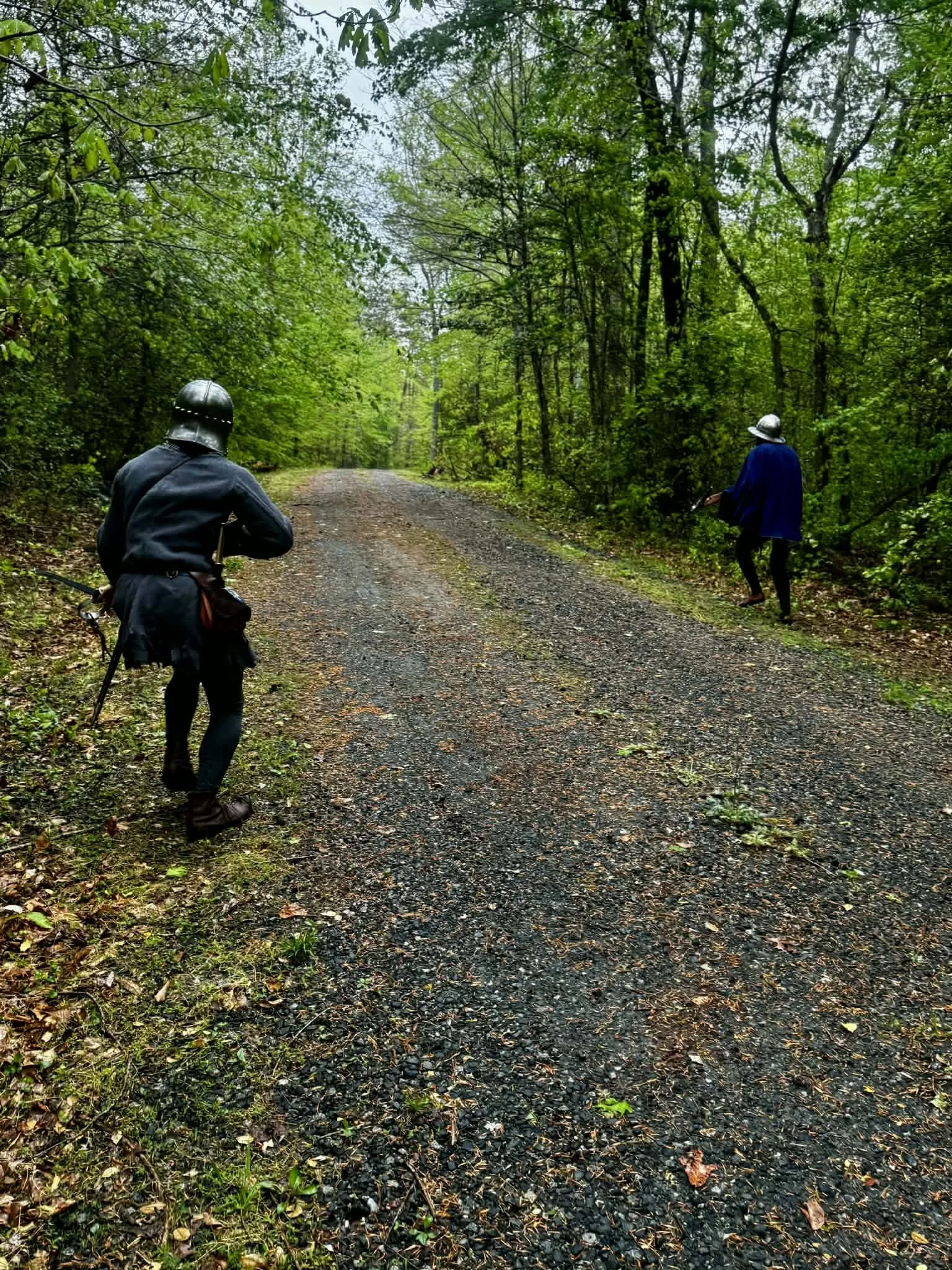
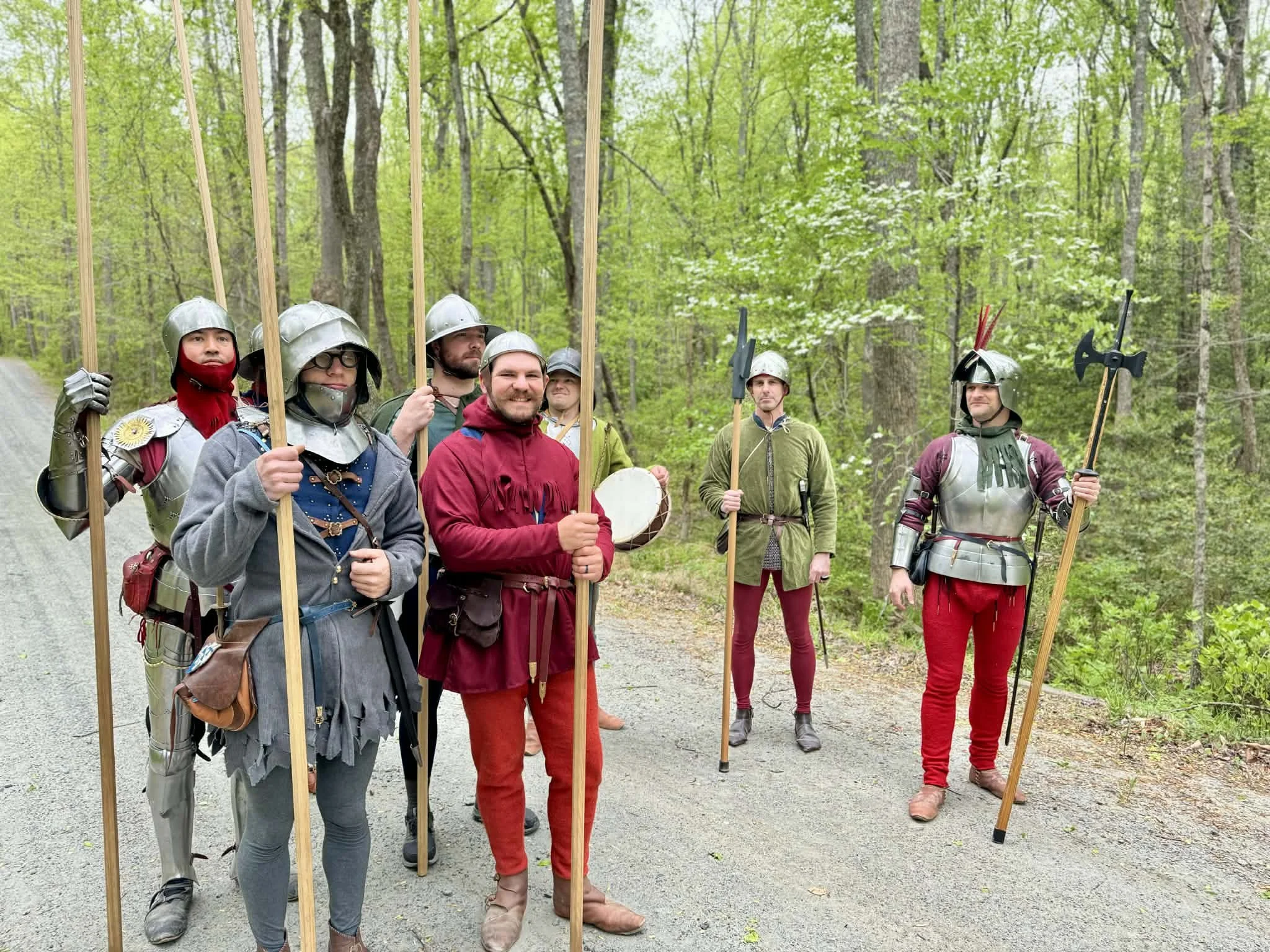
After a few tries, the group was performing well, but began to play the game instead of train. They would see the color of the flag, and begin moving independently, rather than following the orders of their officers. In response, I used combinations of flags that the main group hadn't been briefed on, and told only Will the meaning. This would encourage the group to listen to the officer and pass along the actual information of the flag so that he could "decide" what the group should do.
While this flag system takes away commander level tactical decisions of whether to attack, defend, or retreat, this exercise reinforces the specific training of the group's roles and the chain of command. I am happy with this setup. Training that targets a subset of the tasks of a person's job might not be good "simulation," but can make for much more efficient training. For example, in fencing, striking a pell is a great way to train distance judgement and power, but fencing someone to train these qualities is not initially an efficient use of the partner’s time.
I'm happy with how the patrols went. I think the progression of flags was necessary, and in the future, with one or two extra volunteers, we could increase the number of signals that could be sent. By the end, people were exhausted, but were performing smoothly. In fact, for one iteration Drew Schulz was able to detect me as I waited for an ambush, and because of this the group was actually able to counter ambush me.
Miscellaneous Thoughts
This year we were in a larger and more rustic cabin camp. It had more space for exercises, which people seemed to enjoy, and we are likely to return. Generally, Muster is likely to remain a cabin-based event in the near future, despite the fact that the cabins are not medieval and break immersion. This is because the time associated with setting up a camp can significantly eat up training time, and the cost of tents and/or furniture and sleeping arrangements can present a significant barrier to entry. For a 46 hour event, setup and takedown of a fully medieval camp with tents, tables, furniture and other equipment could take a total of 6 hours, which, after removing sleeping time, could represent a loss of roughly 25% of usable training time. Muster is first and foremost a training event - immersion and simulation are auxiliary, supporting goals.
Unseasonably hot weather was an issue, but we managed it well, with frequent rest breaks and hydration. In the future, I will create a contingency plan that takes this (as well as thunderstorms) into account. Similarly, I was careful to track the energy levels of the participants throughout the event. I think the pace was mostly okay, if just slightly too much. I think easing up slightly on the energy demands, possibly by tightening up the schedule or adding an extra day, can improve training outcomes.
Final Thoughts
Overall, Muster 2026 was a fantastic success. We achieved all of our major training objectives, and there were no major injuries. There are some things that I would have done differently if I were to do it again, but would not do for 2027. Separately, there are some changes that would not be appropriate for 2026, but I will definitely make for 2027.
I have big plans for 2027, and for the preparation for a new US contingent to Feldlager, so stay tuned!
